A hero runs to the right and the scenery slides smoothly to the left. In 1990, the owner of a games console would hardly have given this a second thought. On an IBM-compatible PC, that kind of scrolling was still a problem to solve: video memory and redraw speed stood in the way. A small team found a solution, and soon Commander Keen was running across the screen—a boy building a spaceship out of household odds and ends. Apogee released the game in December 1990. Two months later, its creators had a studio of their own: id Software.
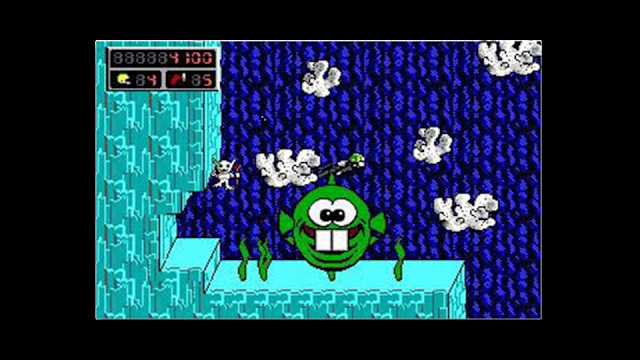
Keen's success gave the team the chance to make its own games. Several steps still separated it from the shooters to come: Rescue Rover, Dangerous Dave in the Haunted Mansion and Hovertank, small projects connected with its work for Softdisk. Hovertank already offered a first-person view; Catacomb 3-D added textured walls. The computer was being asked to draw increasingly complicated scenes, but the developers were reluctant to give up speed. Every bit of time saved paid for another detail: a wall, a corner, an enemy ahead.
In Wolfenstein 3D, released in 1992, walls followed a strict grid and enemies were flat sprites. On a plan, such a world looks meagre. From inside, it feels rather different: a corridor rushes towards you, a door opens, and the guard behind it is already raising his weapon. Those constraints kept the game fast. The player did not have to pay for free-form geometry—still absent—with a slowdown at the worst possible moment in a fight.
In December 1993, Doom made its spaces more varied. Floors and ceilings could have different heights, walls no longer followed Wolfenstein's rectangular grid, and lighting gave rooms distinct moods. What happened outside the single-player campaign proved even more consequential. People connected their computers to play together or fight a deathmatch. A familiar level now had to be studied for a different reason: to work out where an opponent would appear, which route they would take and whether you could intercept them before they reached a weapon. The map became a place to compete, rather than merely a path through monsters placed in advance.
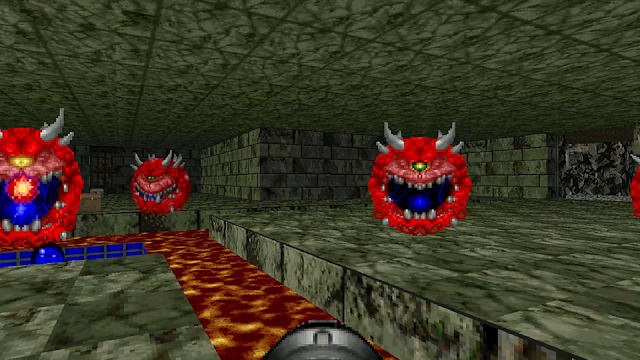
Doom's maps, images and sounds lived in WAD files, separate from the executable. You could play somebody else's level, find an editor and try building your own. Doom II expanded on that foundation in 1994; alongside it came Heretic and Hexen, with id Software acting as technology partner and publisher. Players grew accustomed to the idea that a game could be remade. Source releases would later widen their options, but it began with accessible assets, editors and the desire to show other people a map of your own.
Quake, in 1996, demanded technical work on a different scale. Levels became fully three-dimensional spaces and polygonal models replaced sprite enemies. You could stand above another player, look up and follow a rocket through the air. The engine had to cull unseen parts of that world, light it and draw it quickly on computers that did not necessarily have a graphics accelerator. Software rendering therefore existed alongside emerging hardware-accelerated versions. The later source release preserved this history in the structure of the project itself: WinQuake, GLQuake and QuakeWorld addressed different sides of the same game.
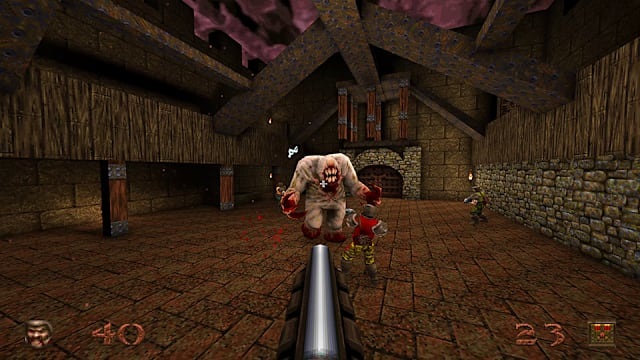
A fast computer alone was not enough for a network match. A command had to reach the server and its reply had to return. If the picture waited for every exchange, even a step forward felt late. QuakeWorld let the client reproduce its own movement ahead of time, then reconcile it with the server. On screen, the player was already walking while confirmation was still travelling through the network. This solution needed refinement too: release notes record fixes to prediction, steps, frame rates and demo recording. The effort to make online movement responsive began long before Q2PRO-X.