On this book's cover, a person sits before many screens showing Q2PRO-X. On one, greenery covers a familiar arena; on another, the sky darkens overhead. Light, surfaces and air change from screen to screen. Above them is an enormous number. The picture has a particular history: in August 2026, a question arose about how many visual combinations the client already permitted. The answer proved far more interesting than a long list of effects.
One Map, Thousands of Decisions
Imagine setting up an ordinary scene. First we choose snow instead of rain, then a sky, a light colour and wall materials. Each decision seems small, but the next applies to all the combinations already made. By hand, we might find a few favourite looks and stop there. The AVFX preset generator offered a different way to work: describe the kind of scene you want, press Generate and see a combination you might never have thought of yourself.
Users chose the main atmosphere, secondary airborne component, sky, celestial bodies, meteors and ships, atmospheric effects, surfaces, water and puddles. Any area could be fixed or left to chance. Materials and wildlife had separate choices: random selection, forced on or forced off. Full surface coverage was independent too. The generator could thus surprise people in the details without contradicting their main wish—for example, a map without animals.
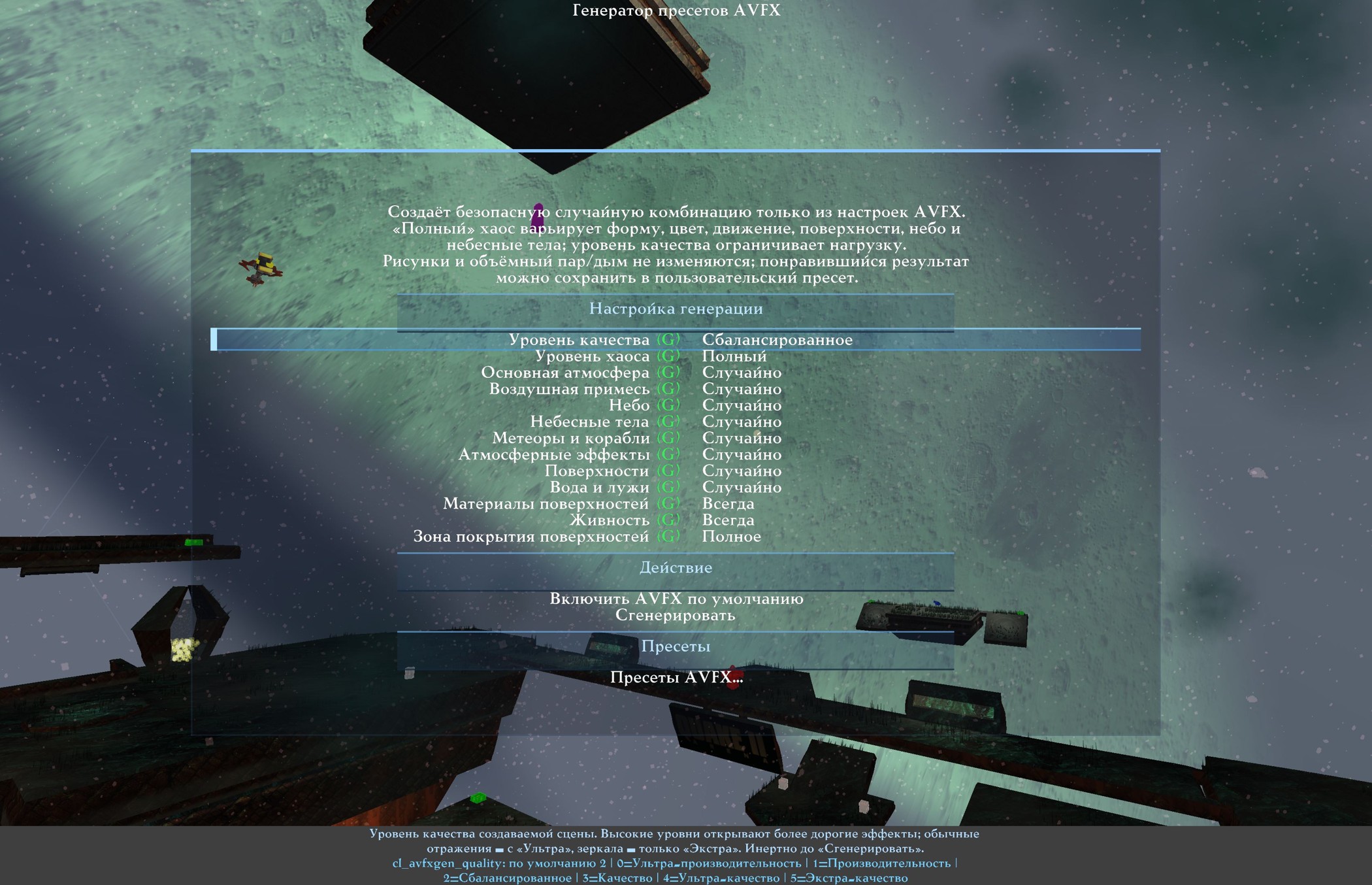
Smart Chaos kept combinations more familiar. Full Chaos also varied the shape, colour and movement of active families within defined ranges. That did not permit every possible set of values. With rain disabled, requiring rain puddles needed reconciliation; lightning could not silently turn a fixed snowfall into a thunderstorm either. Incompatible requests were explained before a scene was applied.
Six quality levels limited complexity. Volumetric clouds and space skies were not available at the lightest level; model reflections began at Ultra Quality and mirrors at Extra Quality. These were limits on effect selection and cost, not a promise of identical FPS on every computer and map. A generation seed and short summary made it possible to return to a discovery; the result could be saved as an ordinary user preset.
The Number on the Cover
The calculation dated 21 August concerned Q2PRO-X 1.5. It examined 2,224 unique control variables and identified 482 independent visual axes in twenty categories. Numeric sliders—for example, an arbitrary raindrop size—were excluded from the finite count. That alone made the exercise more conservative than multiplying every possible menu value together.
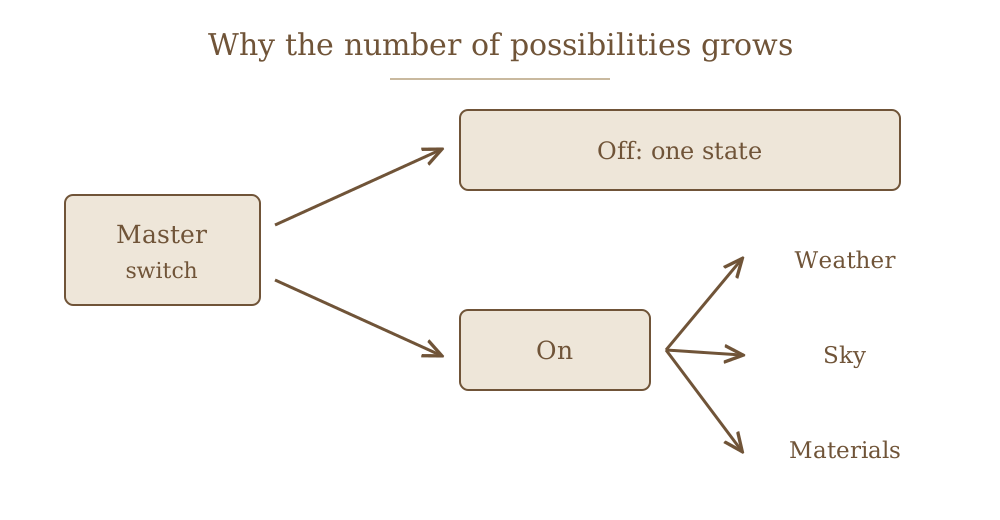
It was especially important not to count what was absent from the screen. When the AVFX master switch is off, all the variations of its child effects do not become different scenes: they are all off. The same reasoning was applied to dependent families, light sources and reflections. Ready-made presets did not multiply the result either: they select settings already counted, rather than adding another visual dimension. At that point, 82 supplied visual presets were counted separately.
After dependencies were accounted for, the model produced approximately 1.24 × 10¹⁶¹ graphical configurations—a 162-digit number. That is the number on the cover. It describes the whole examined space of client graphics settings, not the number of presets the random generator is guaranteed to produce. Nor does it prove that every pair of frames looks different: on a map without suitable water, some water settings will simply have no visible effect.
Consider what examining them would mean in ordinary actions. Spending ten seconds on each variant without a break would take about 3.92 × 10¹⁵⁴ years. The calculation compared that with an assumed age of the Universe of 13.8 billion years: roughly 2.84 × 10¹⁴⁴ such lifetimes. Even involving all 8.2 billion people in the population estimate used at the time barely changed the practical conclusion. The viewing could never be finished.
A large number did not remove the need for checking. The study went through three revisions as master switches and black-hole reflection dependencies were clarified. The result was accepted as an illustrative approximation of diversity, rather than a mathematical proof of the number of unique images. User drawings and textures remained outside the finite figure. New Q2PRO-X 1.6 surfaces were absent from the August calculation too: it is a historical snapshot of Q2PRO-X 1.5, not something that can silently be presented as a recount for a later version.
Keeping the World You Found
After a successful generation, people wanted to keep it as well as admire it. Q2PRO-X 1.5 provided twelve ordinary global user slots and another twelve for the current mod. Six global and six mod-specific slots were reserved for music presets. Names could be edited in the menu, and updates were not supposed to overwrite these personal discoveries. Supplied packs, including HDR variants, offered a starting point for anyone not yet ready to build a scene from scratch.
A music preset saved the selected PROMODJ online-player track together with AVFX. A cold sky, rain or bright space scenery could thus have its own soundtrack. Loading an ordinary preset stopped the previous music preset's track: the new appearance did not inherit someone else's music by accident. The generator itself did not control music; it prepared a visual scene that could then be saved and arranged to taste.
A preset carried another responsibility: loading it also changed saved drawings and volumetric steam on maps. A different world could not be loaded with half the previous one's smoke left behind. The complete set of placed authored content was therefore replaced, while the asset library and other slots remained the user's. A good preset became a finished scene worth returning to, rather than a fragile sequence of switches happened upon by chance.
The enormous number of possibilities did not imply that a person needed to see all of them. Finding one was enough: a familiar map worth lingering in, a reason to play the campaign again or a scene worth recording. The generator shortened the search. Saving a preset made the discovery last.