Q2PRO-X's first records date to 29 March, and this chronicle ends on 10 October 2026. Counting both dates gives 196 calendar days. In that time, the client grew from early checks of controls and weapon prediction into a broad collection of graphics, networking and user features, alongside a bot mod and independent studios. The main dates below provide bearings in that crowded history. Client version numbers and OpenTDM-X beta numbers belong to different development lines and should not be read as a single sequence.
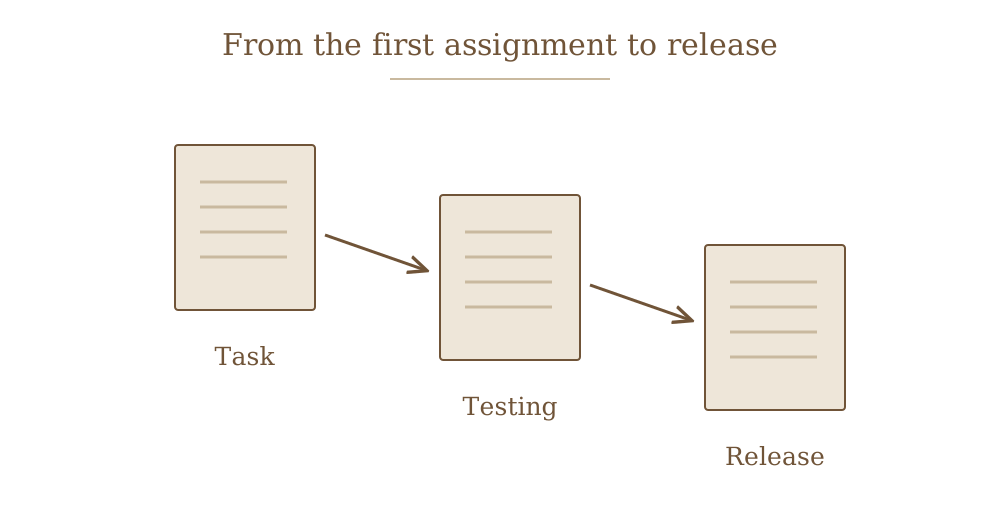
| Period | Developments |
|---|---|
| 29 March | Q2PRO-X begins. Early versions, weapon response, controls and compatibility. |
| April | Interface, demo viewing and communication develop; public Q2PRO-X 1.2 on 29 April. |
| Late April–May | Intensive AVFX, rain and snow development; public Q2PRO-X 1.3 on 17 May. |
| May–early July | Sky, water, HDR and local modes; preparation of Q2PRO-X 1.4. |
| July–August | Materials, wildlife, Network God, timers, compatibility and extensive Q2PRO-X 1.5 testing. |
| 25 August | Q2PRO-X 1.5 published; the next client line, Q2PRO-X 1.6, opens. |
| September | Surfaces and scenery expand, demanding scenes are optimised and duel-bot work develops. |
| 4–6 October | Public OpenTDM-X Beta 11 and Beta 11.1; further work on ztn2dm3 and styles. |
| 8 October | OpenTDM-X Beta 11.2 with q3t2 accepted and released; the map joins Studio research. |
| 9–10 October | Q2PRO-X 1.6, learning research and ztn2dm3 improvements in OpenTDM-X Beta 11.3 continue. |
What the Archive Can Tell Us
The examined archive contained 776 documents setting out tasks. Of these, 520 were main or follow-up assignments, and 256 held accompanying requirements and corrections. Exact content duplicates were excluded; reports of results were not counted as new assignments. This is a document count, not a count of independent features. One capability could generate a long chain of clarifications, especially when a fix returned from an unsuccessful test. The examined documentary collection contained 3,245 Markdown files in total, of which 3,110 had distinct contents.
A snapshot of four related Git trees yielded 9,294 unique commits, 4,739 of which touched code within the chosen scope. Initial source imports, third-party files and automatically generated files were excluded. Available branches included experiments and intermediate builds. A commit here therefore means a recorded change, not a separately finished feature. One idea might pass through several rewrites; a change transferred under another hash also remains a separate record.
June19
July824
August1561
September1379
October · to the 10th956
The chart begins in June because the available code history does not cover March–May in a comparable form. An early tree import cannot be presented as the entire project having been written at once. October ends at the book's cutoff. The same snapshot counted 984,895 added lines, 102,743 deletions and 2,735 code-file paths. These describe editing events: a line could be rewritten repeatedly or removed after an experiment. They are neither the final program's size nor a measure from which development productivity can be calculated.
Time Spent Testing Again
The archive preserves many checks in detail, but it is not a continuous timesheet. It cannot honestly yield the total hours of development, repeated matches, demo analysis and waiting for builds. A report date does not say how many uninterrupted hours the work took; a demo's duration is not the time spent studying it. Instead of an invented enormous total, this book offers concrete evidence: successive early betas, repeated failures after material fixes, eight rounds of network tests, demanding-scene comparisons and dozens of public recordings used to investigate tactics.
Some work inevitably had to be repeated: revisit an episode already fixed, retake measurements with matching configurations, launch an older build for comparison or play another match after changing one rule. Five returns to material re-enabling left users with one working setting. Faster shader preparation added no menu item, but shortened the wait. The change history reflects that work; counting only new features scarcely notices it.
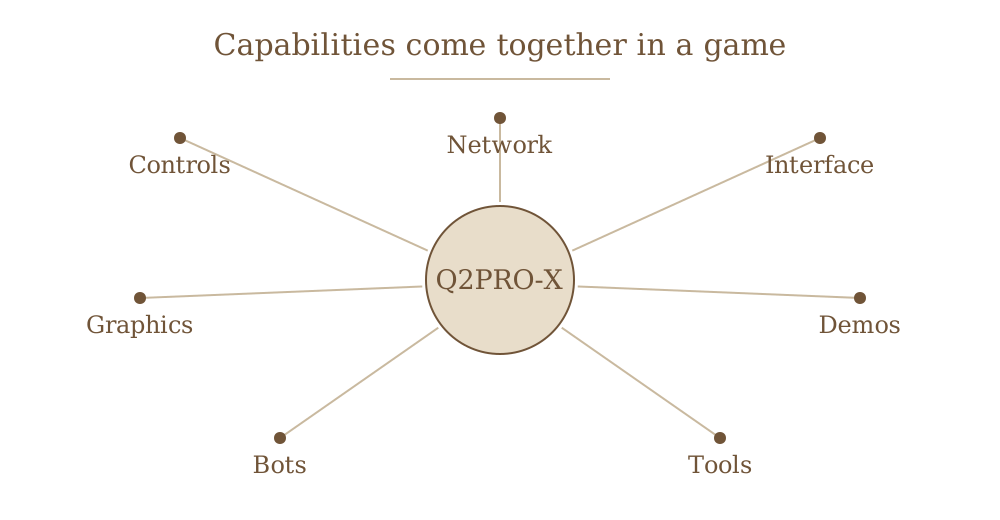
The project's capabilities could be grouped into 99 subject areas. Successive fixes to one function were not counted as new features, and large effect families were not divided into every slider. The list includes everyday player tools as well as independent applications for preparing maps and training bots.