A human advanced at point-blank range with a hyperblaster while the bot held a rocket launcher and stayed silent. It had not frozen: each rule was faithfully doing its job. One forbade wasting time switching weapons; another forbade firing at the risk of killing itself with the blast. Together, they produced the one outcome the player had insisted must never happen: several seconds under fire without a reply. The investigation worked backwards from a ready shot—what could the bot do now, and which decision deprived it of that opportunity?
Switching could be fatal too. A rocket almost finished a human off; the bot drew a super shotgun and died before the change completed. The time to the next shot from the raised weapon had to be compared with the time to the first shot from another. The railgun remained useful for an opening hit and catching a respawn. But in a close pursuit of a wounded opponent, a burst or a spread often hit more reliably. One list of ‘best weapons’ could not cover all these situations.
Chasing Around a Loop
On a looped map, a human ahead on score could stop fighting altogether. They listened for the bot and left by another corridor. The chase repeated, circuit after circuit. Interception needed route changes, exit control and quiet waiting; even the railgun mattered, because a held weapon can give itself away by sound. Once a weak opponent appeared in direct view, however, a detour lost its purpose. An elaborate manoeuvre could give the human time to rebuild their stack.
A similar choice followed a frag. An available shot at a respawn on compact q2duel5 was worth taking immediately; chasing across a larger level left armour and weapons unclaimed. Small items mattered too. A stimpack or shard could raise a stack beyond the threshold of a single railgun kill, giving an unarmed opponent another chance to escape. Item value was tied to travel distance and the next likely encounter.
Four Styles
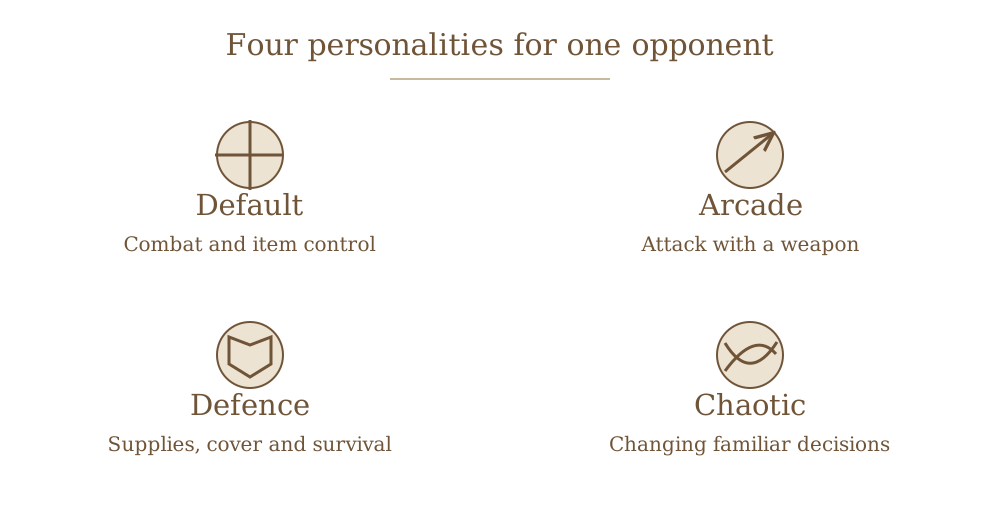
Four styles appeared: default, arcade, defence and chaotic. The first retained the main tactics; the second favoured fast movement and fighting; the third favoured survival, stack and control. The fourth varied its preferences during a game. A style could be set in a bot's profile and changed temporarily by vote. Their introduction required another comparison of versions: default had grown weaker, while defence sometimes refused even an available frag.
Arcade initially exposed an overly literal reading of attack: a bare bot ran at a prepared human. Active combat still requires a weapon, ammunition and protection; useful items along the way had to retain their place in the route. Defence made the opposite mistake, releasing an almost-finished opponent and ignoring a safe pickup. Changes to both styles returned to q2duel5, where speed and pressure already had a standard for comparison.
The shooting scale below skill 100 was checked separately. Low levels sometimes retained such accurate railgun aim that difficulty differences lost meaning. Accuracy reduction was made gradual without altering shooting at 100 or above. Adaptive ping had to be traced from behaviour to the server's response to an external browser. The mod's scoreboard could show latency for a bot while the browser still showed zero. Correcting that number was checked separately from perception and action timing.
OpenTDM-X Beta 11 was accepted for public installation on 4 October. Styles, weapon behaviour, pressure, escapes from poor positions and new profiles formed one package. Its change list compared it with the server's Beta 10. Long chains of internal fixes were reduced to their outcome: a server operator needed to install an update, not reconstruct its history from intermediate archives.