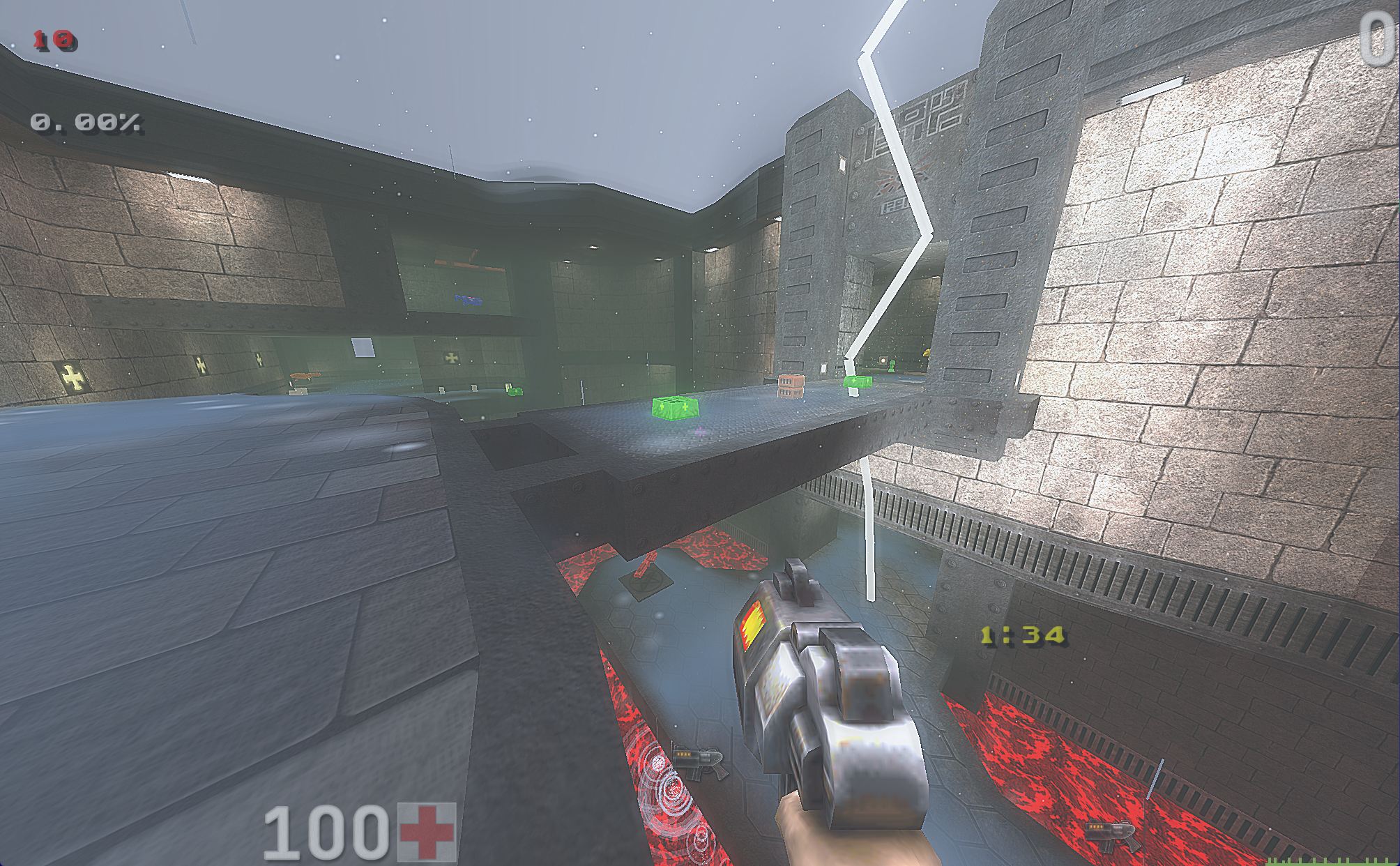
Rain appeared in the first builds of the Q2PRO-X 1.3 line, begun on 29 April. The new system was named Advanced Visual Effects—AVFX. Nobody rebuilt the maps for it: snow and water entered the same courtyards, corridors and shafts that players had crossed for years. The remaining task was to determine where the sky was, how far a drop would fall and what lay beneath it. Otherwise, rain would pass through ceilings and snow would whiten an exposed staircase and an interior room alike.
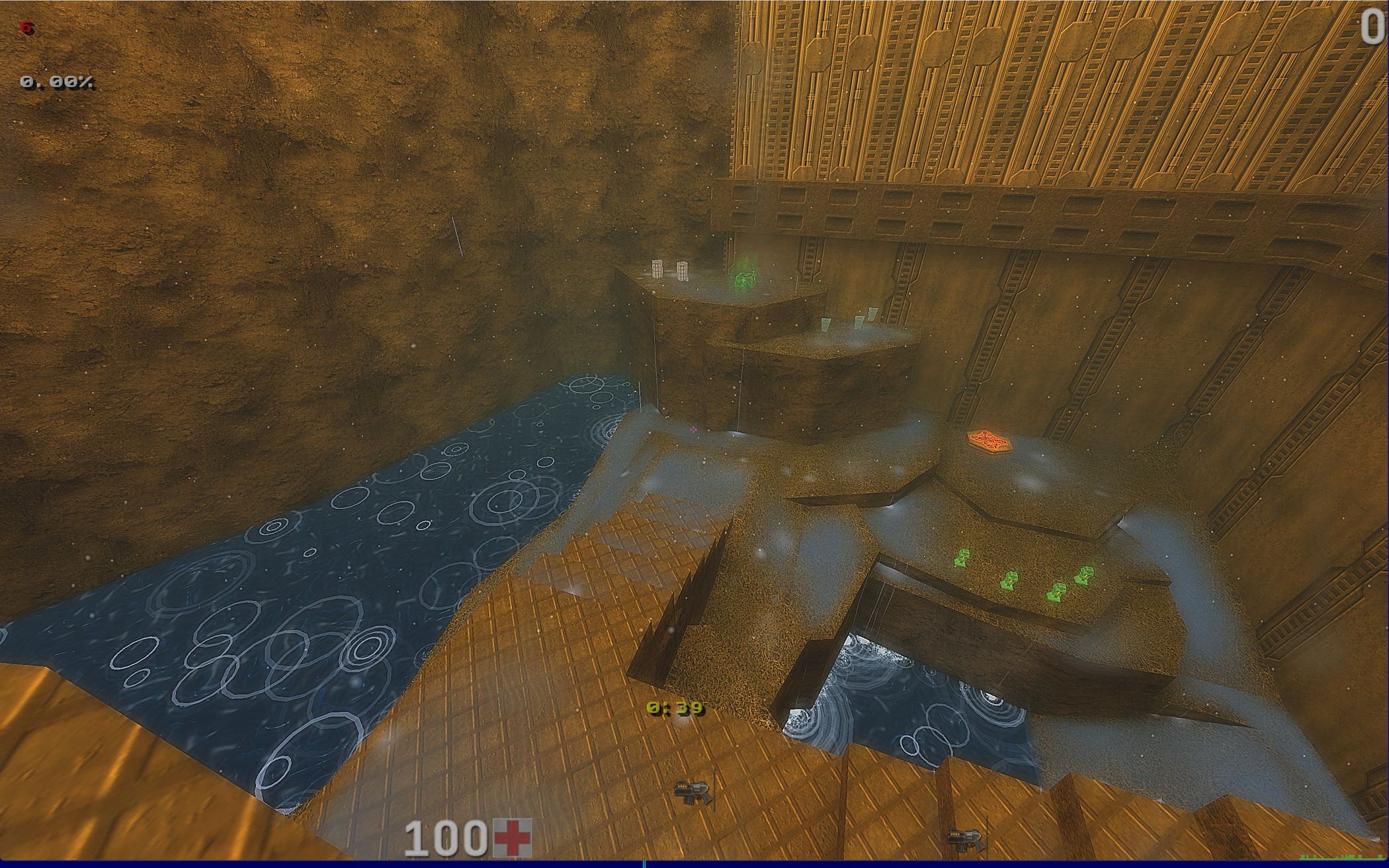
A drop made rings on water and broke into splashes on stone. Floors darkened, puddles formed and reflections appeared in them. Individual effects could be adjusted fairly quickly; together, they sometimes looked as though they belonged to different games. Get transparency wrong and water became paint. Get drawing order wrong and a reflection sat on top of the floor like a separate picture. What needed adjustment was an entire wet scene: its lighting, surfaces and everything that landed on them.
Water ran to the edge of an upper platform and fell below, gradually building another puddle. In a May test, that lower puddle behaved oddly: looking away made it disappear; turning back made it appear full at once. The cause lay in its relationship with the stream. The program created the water while drawing the stream and forgot it when there was no reason to draw. Accumulation was separated from visibility. The platform could now keep getting wet even after the player entered another room.
This memory needed rules of its own. A source can stop feeding a stream without the water below disappearing that second. A camera can enter another room without a puddle ceasing to develop. Yet there is no sense in continually drawing an invisible mark. State and image were therefore separated: one keeps track of how much water arrived and what happens to it; the other decides what the current frame should show. The same distinction would later help with blood, reflections and autumn-scene optimisation. Watching rain was uncovering general rules for building the world.
Water also demanded a sense of scale. A large surface receives rain rings and light; a small puddle may show a footstep, bubble or brief splash. Lava and other liquids have their own appearance and must not accidentally inherit water's tint. Fog, spray, foam and a wet lens belonged to the same scene, but did not have to be enabled together. Players could retain a useful layer and remove a distracting one. Controls for particle and effect families developed alongside their appearance, and master switches were checked for work continuing invisibly after shutdown.
Snow made the old map's seams particularly obvious. Coverage calculated separately for each polygon exposed its boundaries; a continuous white plane, conversely, passed through steps. Even footprints needed attention at first: random dents do not look like steps with a left and a right foot. Testers crossed the snowy courtyard again, inspected the edges and returned to the surface calculations.
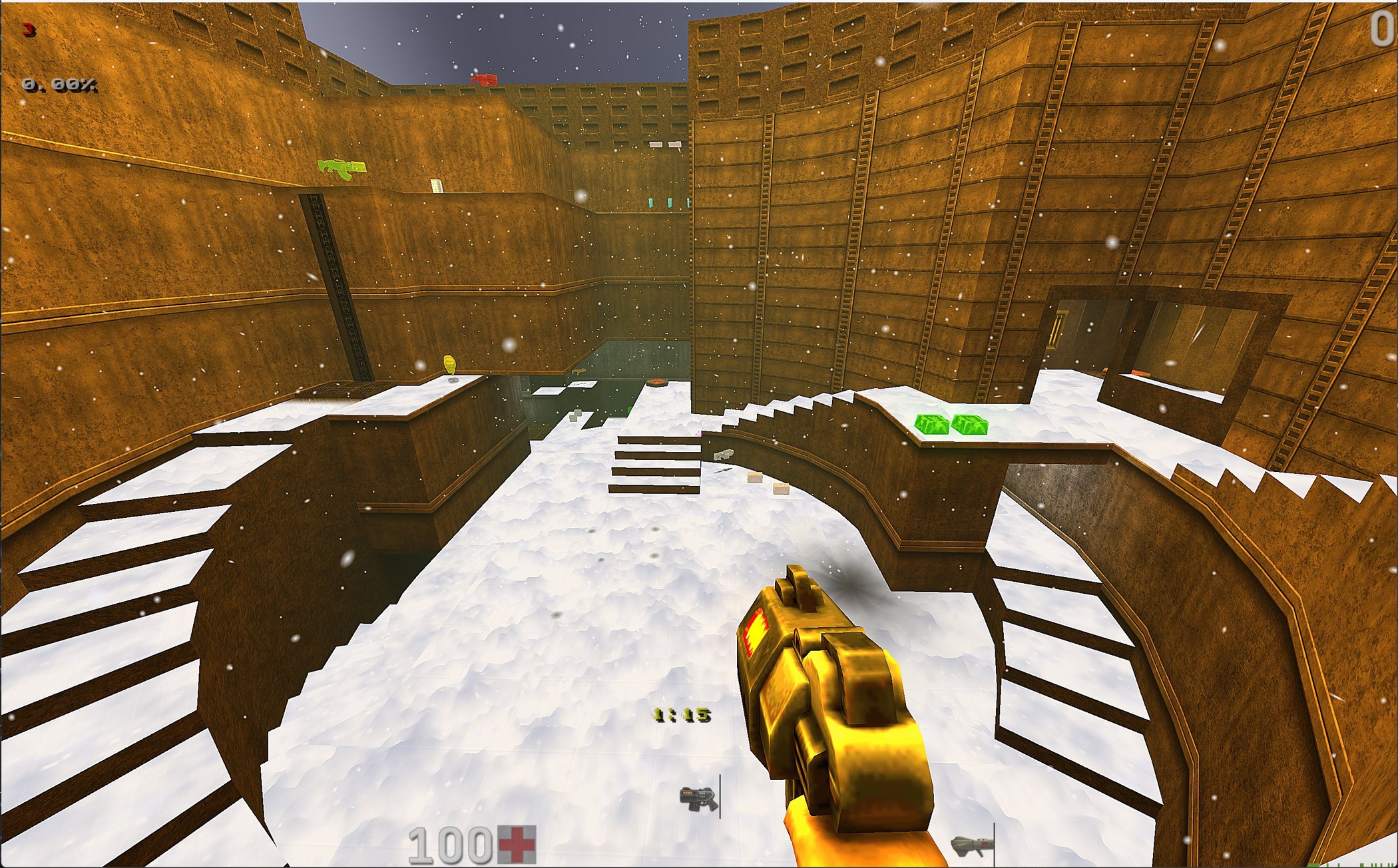
The first approach to volumetric snow led nowhere. Joining sparse particle-impact points into a continuous surface produced floating plates, stripes on stairs and snow in unsuitable rooms. An unknown cell in the field was mistakenly treated as existing floor. That approach was stopped in favour of what was actually known about the map: where a surface existed, whether precipitation could reach it and how it sloped. Research compared GPU snow-accumulation approaches, including published graphics examples. The GPU took on the covering's pattern, relief, sheen and soft edges; geometry remained the basis for deciding where snow was allowed to exist at all.
Moving close to a snowdrift quickly removed any leniency. A light patch might suffice from afar; nearby, its height above a step, the depth of a footprint and the shadow on a slope became visible. Different snow materials and lighting from the Sun, Moon and lamps followed. A patch adjusted in daylight was reopened at night: pleasing whiteness could become an overexposed blotch. A tester walked the map, turned and rose above the surface—and found edges absent from the screenshot chosen for the report.
In May, the snowy world began to freeze—the incident with which this book opened. Two real sources of wasted work were found first: on maps without water, the program searched for water too often, and checks for open sky repeated unnecessarily. Both were fixed. Snow became cheaper to calculate, but the picture still stopped. Those bugs had existed alongside the main fault, rather than explained it. An average frame-rate counter offered little help: between freezes the game ran well; during them, the three-dimensional world stopped updating while menus and sound carried on.
A shot into a surface where snow had already accumulated supplied the answer. Its mark and particles appeared—and the world revived. Drawing them restored OpenGL to the state the engine expected. The new snow pass had changed graphics settings directly, bypassing the engine's internal tracking; the next frame began on the false assumption that everything was already configured correctly. The shot happened to repair that disagreement. Settings were then restored after the snow pass and the engine's tracking brought into agreement. Repeat tests on ztn2dm3 and q2dm8 confirmed the fix on 17 May.
Less visible work continued during the hunt for the freezes: removing repeated highlight calculations, comparing particle costs and adjusting graphics-pass order. The faster version was not always kept. Frame comparisons could reveal a changed tint, forcing a return to the previous blending and a search for savings elsewhere. Some measurements were wasted: a different bloom setting or frame limiter had remained in one configuration. The whole run then had to be repeated with identical settings. Such days added no line to the client's feature list.
Q2PRO-X 1.3 was published on 17 May. Precipitation now accumulated on old maps, water flowed between platforms and snow retained footprints. Puddles reflected the sky, though it was not yet as detailed as intended. The following weeks were spent giving those wet courtyards a recognisable Moon, stars and changing light overhead.