On a familiar arena, it is easy to hear a shot before seeing who fired it. But if a Strogg comes around the corner instead of another player, habit no longer supplies every answer. It has a different weapon and pace of attack; a passage well suited to a duel can become a trap against several monsters. Experiments with this kind of single-player game began in May, after Q2PRO-X 1.3. By Q2PRO-X 1.5, they formed a separate part of the client, with their own rules, settings and game library.
Why a Separate Game DLL Was Needed
Many earlier changes could be shown without interfering with the server's decisions: drawing snow, lighting a wall or processing sound differently. A picture cannot decide how much damage lava deals or where a new monster appears, however. In Quake II, those duties belong to the game library, the game DLL. Q2PRO-X received its own version in a separate folder. The ordinary baseq2 library stayed in place, and the new rules applied to local single-player. They did not travel with a connecting client onto somebody else's server.
The first idea for shaking up the campaign was simple: stop knowing in advance what waits behind a door. A mutator changed the arrangement of items and monsters. Conservative settings kept opponents at roughly the same strength; a freer mode allowed neighbouring tiers, and a chaotic mode made encounters less predictable. Keys and items required to finish a level were protected. Without that safeguard, novelty would end at the first locked door for which no key remained.
Randomness could be saved too. A zero seed generated a new arrangement on loading, while a specified number allowed it to be repeated. That helped both play and debugging: an unfortunate case no longer vanished on the next launch. Replacements still had to respect the level itself. An aquatic monster stranded on a dry platform did not make the campaign more interesting; it merely exposed a programming mistake.
Monsters on Deathmatch Maps
A multiplayer map already has spawn points, weapons, armour and corridors built for combat. Training mode used that foundation: monsters appeared on suitable DM maps even though the game was being played alone. Players could choose their number and difficulty, allow them to respawn and set the delay. A new creature was placed at an unoccupied point; a position immediately beside the player or another living monster did not count as suitable.
Weapons, health, armour, ammunition and power-ups could respawn in their original places. Training therefore did not become a one-off clearance followed by a map with nothing useful left. The player returned for supplies and began to judge familiar routes differently: this lift offers an escape, that corner is a good place to meet a pursuer, and here is somewhere you must not run out of ammunition.
An optional scored round gave the session a measurable goal. Kills earned points, damage received lost them; reaching the chosen total meant victory, while the player's death meant defeat. This was a separate branch of single-player, rather than an early version of OpenTDM-X's duel bots. Strogg and trained opponents solve different problems and follow different logic.
Water You Can No Longer Jump Into
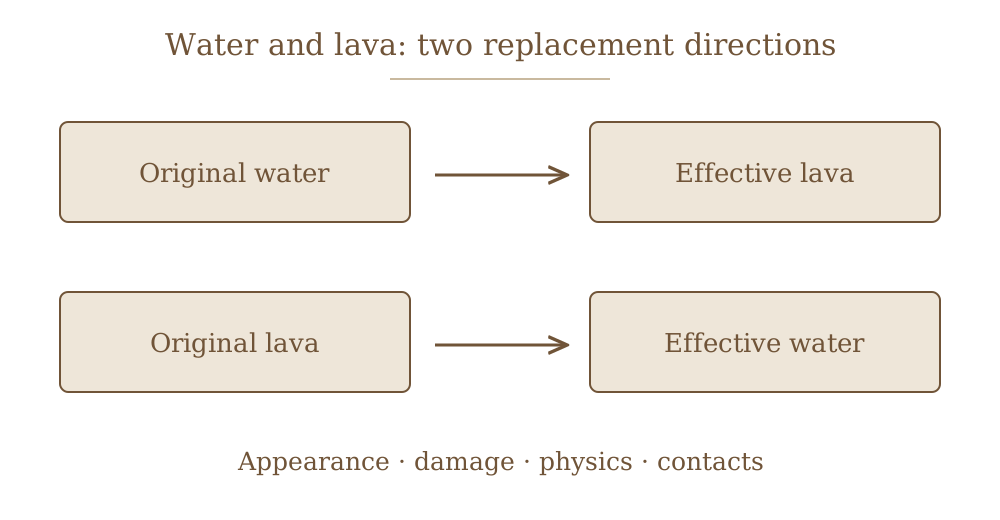
Liquid replacement tested a player's memory even more sharply. On the ordinary map, they might cut through water without thinking; after replacement, real lava lay there. More than its colour changed: the game library applied the new liquid's damage and physics, while visuals and AVFX contacts followed the same substitution. The reverse option turned lava into water. Both directions could be enabled together: each original body of liquid changed independently, without an endless sequence of conversions back and forth.
This was an easy place to create a beautiful but incorrect scene. If water already burned while snow and rain still treated it as cool, the player saw two incompatible accounts of what was happening. Material, damage and contact effects had to be connected. These experiments were limited to single-player; in a network match, a client has no right to turn a safe pool into a hazard on its own.
Familiar Walls, Unfamiliar Silhouettes
Another set of experiments changed the level's visible shape: surfaces gained slopes and irregularities, and suitable sharp corners were rounded. AVFX could follow the altered visible surface so that a puddle or footprint did not float separately from the floor. This changed the image, not the map used for movement: collision retained the original geometry. That distinction matters, and must not be confused with actual liquid replacement or the hardware tessellation developed in the renderer.
Repeated monsters were made visually distinct too. Scale, colour, proportions and asymmetry could vary while hitboxes, damage and behaviour remained unchanged; feet had to stay on the floor. Some other local settings deliberately gave AVFX a gameplay effect: a meteor could hurt a monster or explode a barrel, and lightning could strike a destructible object. Such effects were disabled by default. A handsome sky was not supposed to alter campaign difficulty without permission.
Free World and the ability to watch wildlife arrived later. The important shift had happened earlier: Q2PRO-X was no longer only a different way of looking at Quake II. Within its own single-player game, it let people change the experience itself while keeping the familiar version available alongside those experiments.