On ztn2dm3, the bot that played q2duel5 confidently often looked like a beginner. Here there was red armour, megahealth and open space. A rocket had travelled only part of the distance while the human had already fired a rail and stepped aside. The bot collected a weapon but left the megahealth, missed an item jump and walked away, or lost seconds on the stairs by adrenaline. On this map, its former accuracy could not compensate for the stack it surrendered.
One human route took only seconds: rocket launcher and ammunition, yellow armour, then a rocket jump to the chaingun. Next came its ammunition, two health packs along the way and red armour. Health partly repaid the jump's cost, and two strong weapons were now available. The bot was taught to complete this sequence quickly and adjust it if an item had already been taken. Early versions instead wavered between goals; during that hesitation, the human reached the red armour.
At the step before the railgun, the bot learned the trick and still sometimes left the weapon behind. It landed on the platform, noticed another goal and jumped away; elsewhere, it repeated the jump despite the railgun having just been collected. The whole sequence needed checking: starting position, acceleration, item contact and the next step. A graceful landing alone no longer counted as success.
Lifts and Fire into Cover
Lifts exposed several independent weaknesses. Waiting-for-platform state prevented the bot from finding a firing position even while an opponent rose directly in front of it. A rocket could fly towards where the human stood when fire was pressed and strike the floor after they had ascended. Platform speed and direction, flight time and possible movement changes had to be considered. If a player's protruding body hit an obstacle and the lift stopped or reversed, the old prediction was no longer valid. Falling under a platform required separate navigation recovery; better aiming could not solve it.
Rockets and grenades also had to be checked against room geometry. A human in the megahealth niche could hide their model while remaining within blast range of a wall. A grenade launcher could bounce a projectile around a corner; aiming directly at the body discarded that advantage. Yet endlessly firing into an empty exit consumed every round. Recordings showed both faults: silence beside an occupied niche and shooting the last rocket at somewhere the opponent had long since left.
Individual profiles developed in OpenTDM-X Beta 11.1 as well. Chat lines came from available references, greetings accounted for the current person and connection history, and replies to smileys ceased to be a constant echo. One mixed profile gained special behaviour when far ahead: do not immediately attack an unarmed respawn, approach, drop a weapon with ammunition and allow a few seconds to settle in. This rule applied only to that profile. A projectile already in flight did not become harmless—friendliness did not rewrite physics. Other bots continued the ordinary contest for the result.
An Ubuntu 22.04 build was prepared for public OpenTDM-X Beta 11.1. Package checks found an outdated example server configuration and unrelated client files in the source archive. The packages were rebuilt, separating the mod from the rest of the working folder. Installation and documentation were checked on both platforms.
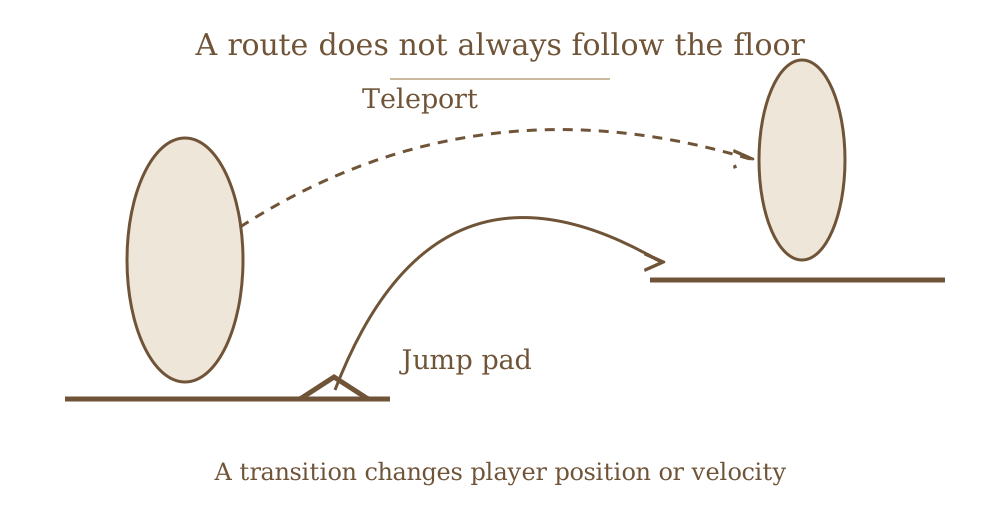
OpenTDM-X Beta 11.2 with q3t2 was accepted and released on 8 October. Teleports moved players instantly and jump pads sharply changed velocity; those transitions could no longer be judged as ordinary running or a broken route. Afterwards, the bot continued towards its next goal. Previous maps remained in testing. On ztn2dm3, moving rocket jumps still needed speeding up, long-range combat choices needed work and delays around adrenaline remained. The next, still unfinished OpenTDM-X Beta 11.3 was addressing them.