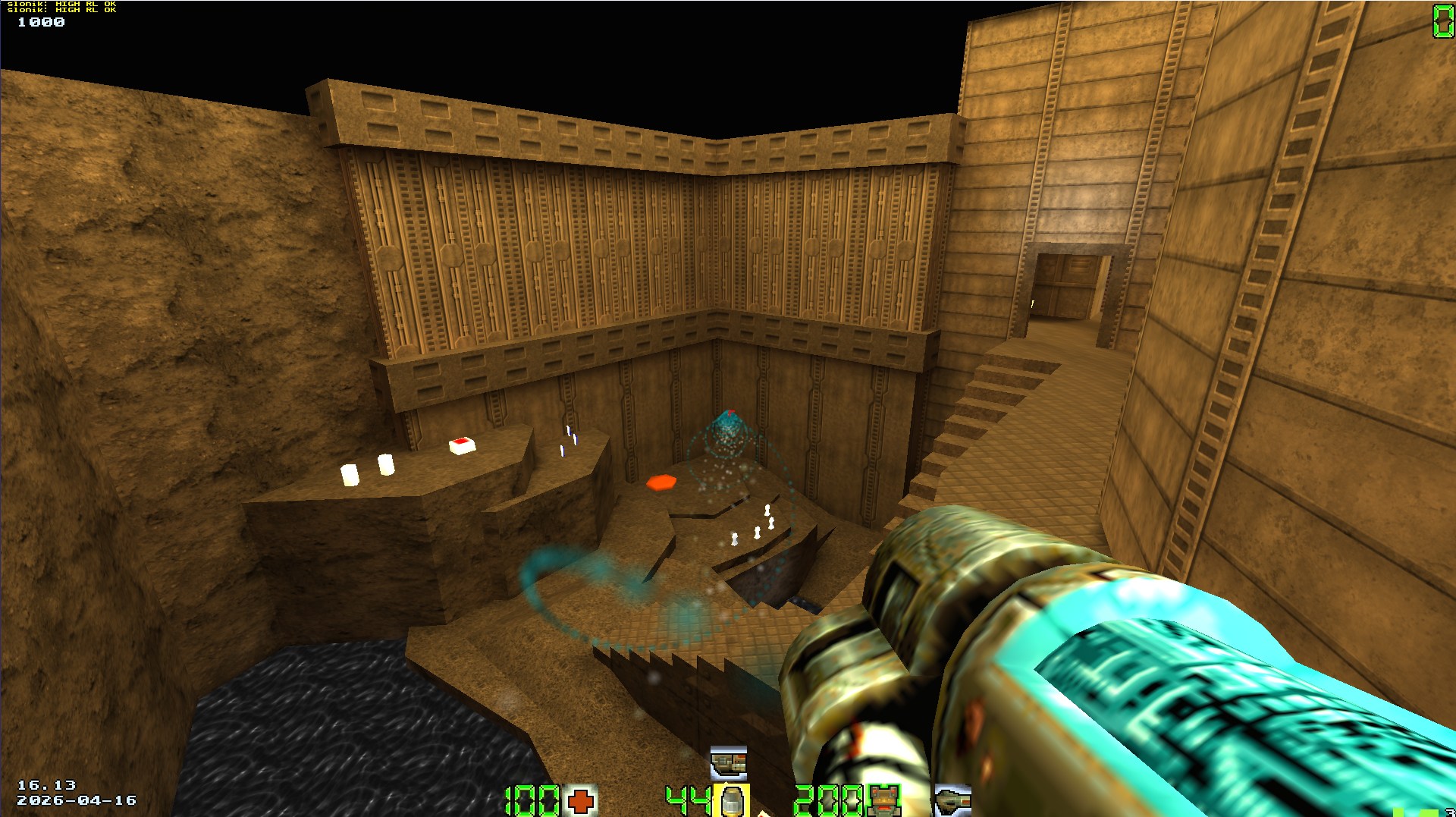
By Q2PRO-X 1.0, movement and weapon prediction shared a ping-adaptation mechanism. The system engaged at the required latency and did not keep flicking on and off when the value hovered around the threshold. Players could nevertheless disable weapon prediction independently of movement prediction. That distinction had to remain consistent in code, menus and hints: a common ping measurement served several settings, each with its own switch.
OpenTDM support also reached the client's team interface. Information came from the server; Q2PRO-X could present it more conveniently, but was not supposed to obtain anything the player had not been told. In tournament play, that boundary matters: making team status easier to read is one thing, gaining information unavailable to an opponent is another.
Q2PRO-X 1.1 and Old Railgun Configurations
A user's configuration exposed a problem absent with default settings: the railgun trail became invisible. One kind of network event bypassed the old drawing path; even after that was repaired, the problem persisted with some settings. A zero particle scale was another cause. The previous client had kept a visible trail through a different formula; the new one faithfully multiplied its size by zero. For the player, the result was the same: no visible shot. Q2PRO-X 1.0 and the following wave of Q2PRO-X 1.1 work restored compatibility for both the ordinary trail and the spiral, testing the actual configurations players supplied.
An old configuration often outlived several computers. Its owner had no intention of examining hundreds of lines just because an executable was new. In disputed cases, the team therefore looked at what the setting used to produce on screen. If a small compatibility path restored the expected railgun trail, it was more useful than demanding that every player reconfigure the game. Cases like these gradually built a compatibility layer around the new code.
Q2PRO-X 1.1A: The Mouse, Settings Search and Cyrillic
Q2PRO-X 1.1A continued the comparison with R1Q2 on 16 April. DirectInput modes were separated, and limited support was added for an old mouse-acceleration fix setting. Reports of unfamiliar movement were traced through command formation and input handling. Altering the physics was tempting: it might immediately feel nicer. But the client could then disagree with the server. Delay and differences in operation order were investigated before changing movement itself.
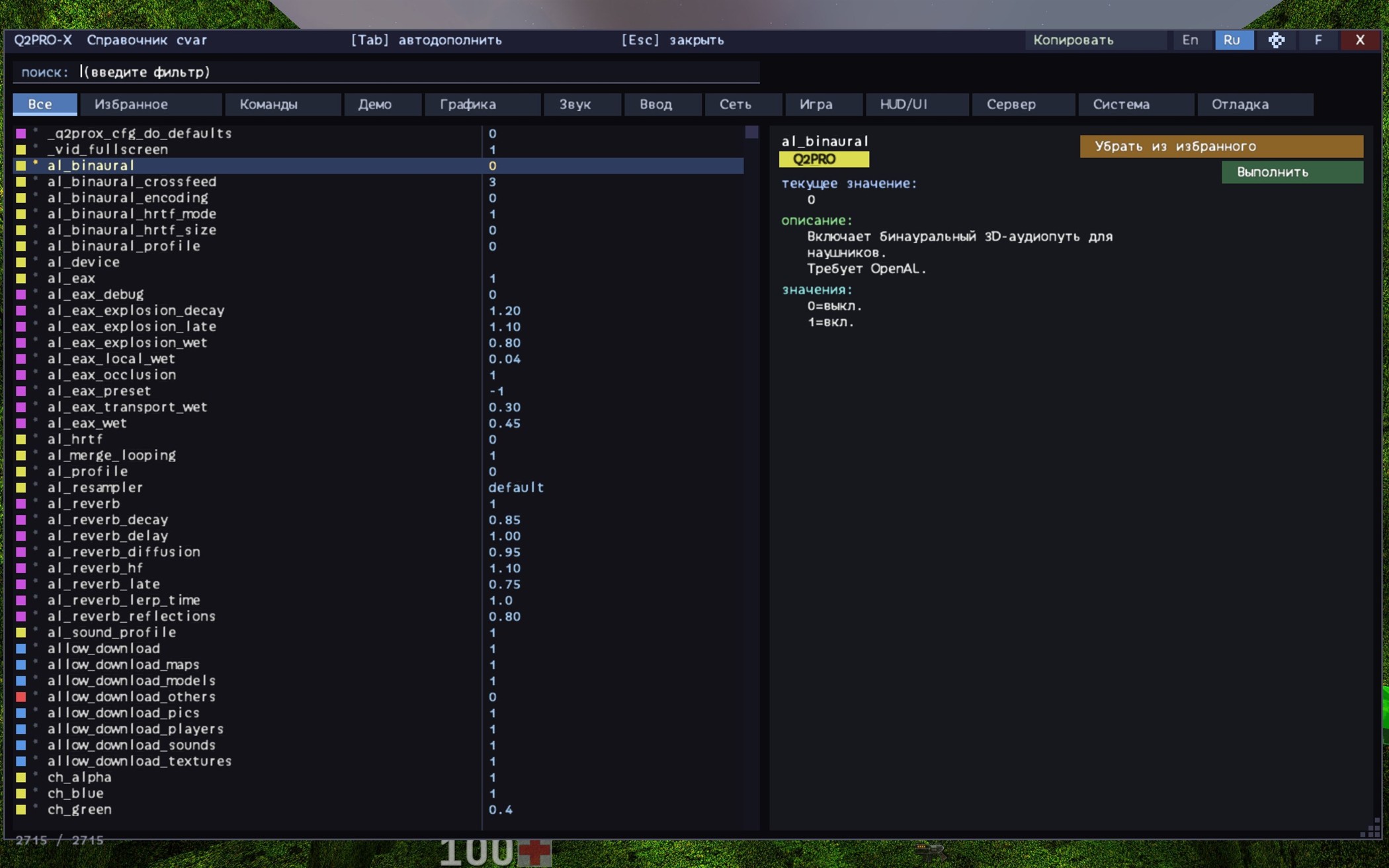
The variable browser gained selection, copying, search clearing and a movable heading. The Russian translation of Q2PRO's basic sections was completed. During testing, opening the browser and pressing Alt+Enter caused a crash; repeated switching revealed an interface memory leak as well. Familiar windows then went through the same sequence again: open, change display mode, return, and check what remained on screen and in memory.