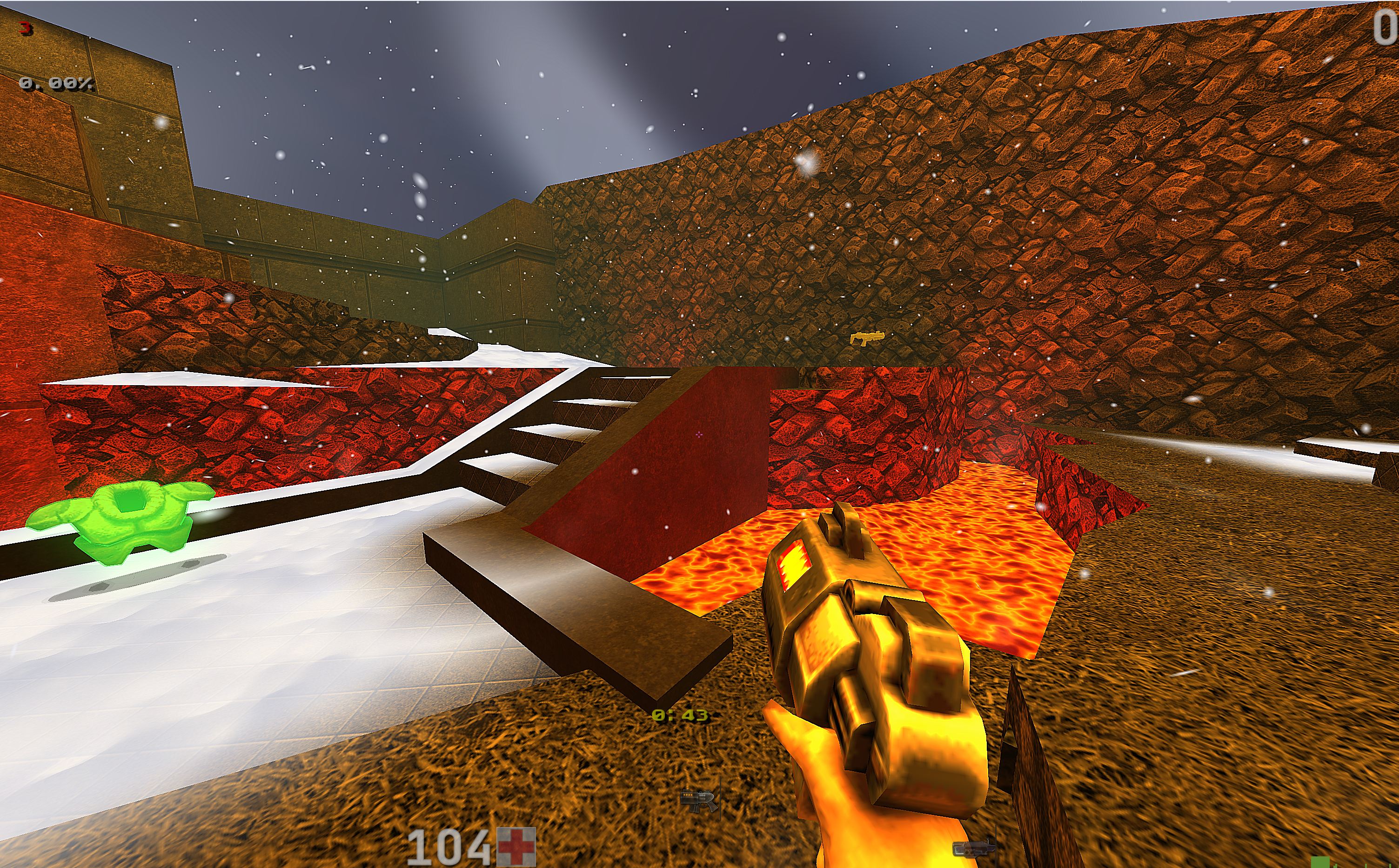
On a winter map, snow catches the eye first. Then a wet streak below a ledge, steam and the reflection of a distant light. Calling all of it ‘improved graphics’ is convenient until you want to keep one thing and remove another. By Q2PRO-X 1.5, AVFX covered several independent families. They could work together, but each had its own job, cost and reason for existing.
Weather and the Air Between Walls
Rain, snow, ash, dust and haze established the air's character. A secondary component could complicate it without replacing it altogether. Storms added lightning, illumination and thunder; a wet lens suggested looking through a picture covered in drops. These effects needed different placement rules: outdoor precipitation, a roof overhead and an underwater camera could not all be served by one unconditional stream of particles.
A flat sky and a cloud with light passing through it solve different problems. Volumetric fog and clouds gave the air depth; rays revealed the direction of illumination. Simpler sky options remained alongside them: weather, blue, starry, space, nebula, sunny and mystical skies. Celestial bodies and moving objects were chosen separately: a planet could stay in place while a comet or ship passed above it. The Moon and black hole belonged to this larger arrangement.
Water Has More Than One Kind of Reflection
A raindrop ripple, a wave, a glint and a reflection do not replace one another. Q2PRO-X developed large bodies of water separately from rain puddles that filled, drained and dried. Model reflections made players, weapons and items visible in them. Screen-space scene reflections reused the visible image of the world. True mirror surfaces formed another system: a floor, slope or wall could reflect its surroundings from a different direction.
That was why ‘reflections on’ said little about the cost of a frame. One scene needed only a watery glint; another required drawing the world and models again for a mirror. Settings separated reflected-object categories and quality. Users could keep the part that made them choose a look in the first place, while performance tests could better identify the GPU's work.
A Wall Acquires Relief
At first, a new surface may look like another texture. Approach from the side and the difference becomes clear: masonry projects outward, stone is uneven, and the floor's edge is no longer perfectly flat. Hardware tessellation divides a surface into smaller patches from which detailed relief can be formed. In Q2PRO-X, it covered architecture and liquids, including water and lava. This path used Native WGL; EGL retained ordinary world rendering. A checkbox could not erase the difference between the two graphics backends.
Tessellation was not merely an extension of the single-player wall-deformation experiment: it could also be used online. But visible relief did not mean the server had acquired new steps or cover. Added brickwork and grass were no reason to change a player's path either. Keeping a beautiful surface connected to the original playable map proved just as important as giving it depth.
Materials were built in layers: mould, water running down walls, greenery, cracks, brickwork and floor or wall coverings. Boards, stone and tiles changed a room's character; their order and coverage determined whether it remained recognisable. Surface objects, three-dimensional grass and wildlife formed neighbouring families. They should not become appendages of one common switch: someone might want an overgrown wall without snakes, or a clean floor with a few decorative details.
Leaving Your Own Mark on a Map
Some scenery could be made as well as selected. Drawing tools placed images on map surfaces; a separate system placed volumetric steam and smoke. Libraries of drawing materials and steam shapes made those assets reusable. This meant working with particular places: smoke rising from this crack, an image remaining on that wall. A random generator was not supposed to erase such placement at the next button press.
Flashlight illumination, monster contacts and the sounds of rain, thunder, footsteps and steam tied the families to nearby events. A shot into snow, water or a hot surface could no longer be represented by the same flash. That requirement later grew into the extensive Q2PRO-X 1.6 contact-effects work: a mark needed the right material, location and lifetime, not merely a convincing colour.
All these features still had a place in ordinary game settings. AVFX could be enabled for demo viewing and restricted differently in an online match; a competitive mode could be selected and expensive families removed. One person wanted to film a snowy arena, another to recognise an opponent's silhouette immediately. They did not have to agree on one mandatory appearance for Quake II.