Development of Q2PRO-X began on the night leading into 29 March 2026. The foundation was already there: Q2PRO, with years of support for online play. The aim was now to see your own shot promptly, find settings more easily and move from another client without unpleasant surprises in the controls. The server still had to decide who won a match. Drawing a shot earlier did not entitle a program to deal damage earlier.
Time passes between a button press and the server's reply. A Quake II client already knew how to display its own movement ahead of confirmation; weapons needed several events predicted at once: animation, muzzle flash, sound and trail. A server message describing the same shot would then arrive. Drawing everything again would produce a duplicate; suppressing too much would remove an effect that belonged there. Work began on two sequences of events that had to agree even though one was always ahead of the other.
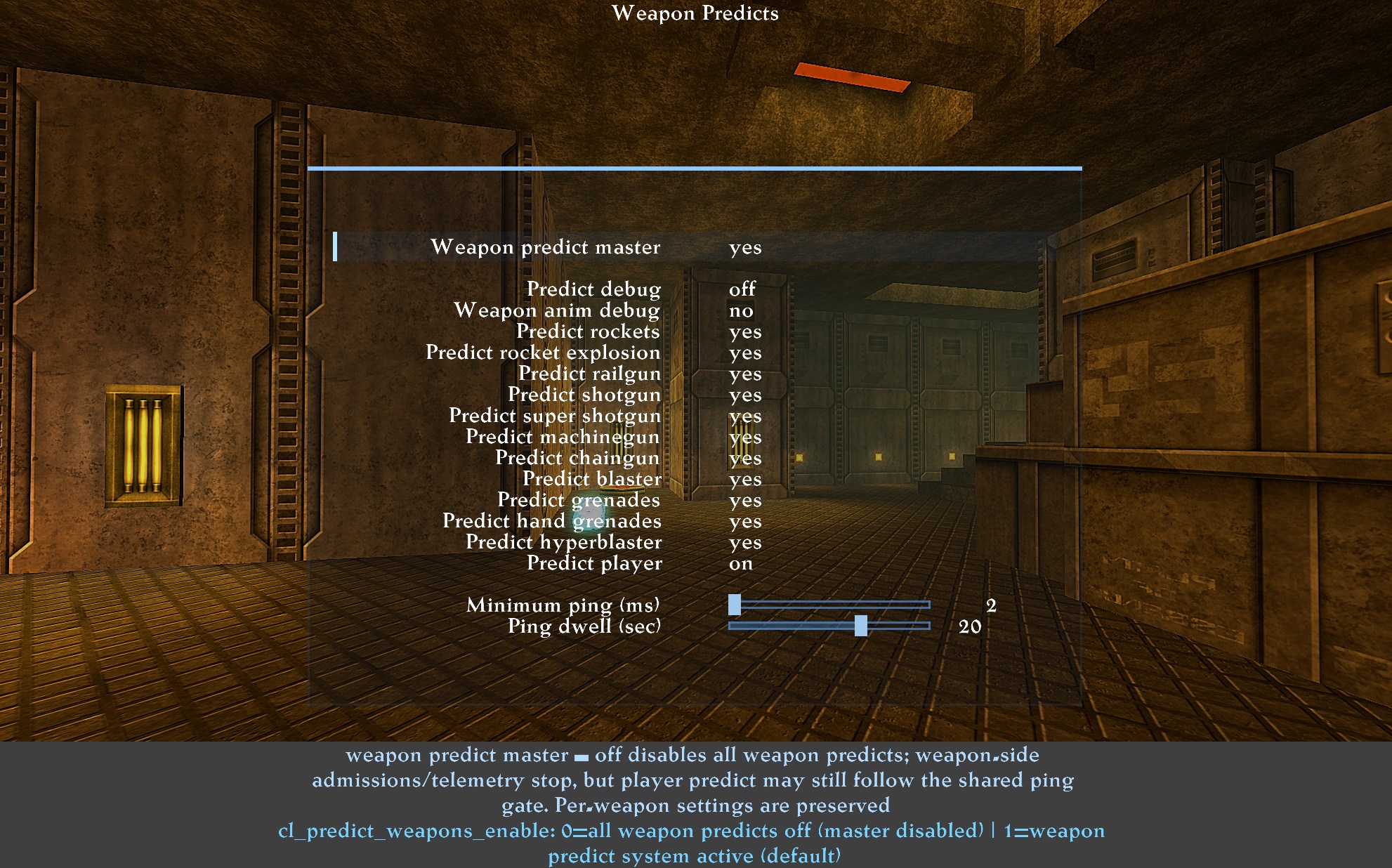
Q2PRO-X 0.95 and Q2PRO-X 0.95-a
Q2PRO-X 0.95 is the first surviving public release. Its package included the executable, libraries, menus, help and Russian guides. Players added it to their own installations: maps, models and configurations remained theirs. This proved a useful compatibility test. Everything might work in a prepared client folder, only for a setting in a player's configuration to change the behaviour of a weapon or window.
Q2PRO-X 0.95-a followed the first feedback. The blaster behaved differently for a single shot and sustained fire. Hiding the weapon model broke prediction, although its visibility should not have affected shooting at all. Graphics-path selection and Alt+F4 behaviour were adjusted alongside those fixes. This small follow-up release was assembled from very specific annoyances people had encountered in play.
Q2PRO-X 0.96: Familiar Resolutions on a New Screen
Q2PRO-X 0.96 turned to display modes. Online players often kept a 4:3 aspect ratio and a low resolution on a widescreen monitor. They gained refresh-rate selection, desktop fullscreen with side bars and a separate display-mode switch. The differences became apparent when minimising and restoring the game, so checking the picture once was not enough. A mouse bug surfaced too: the side bars, where there was no game image, were still involved in input processing.
Q2PRO-X 0.97: The Hyperblaster, Lifts and OLED Protection
Q2PRO-X 0.97 examined the hyperblaster: flash, animation and projectile had to belong to the same shot, and releasing the button had to stop the burst. Laghax readings helped trace delay. Lift jitter caused by the interaction between step smoothing and platform movement was corrected. OLED protection also appeared, taking account of client inactivity and black side bars. This short change list covered faults arising in very different circumstances; a single trial launch could not test them all.
Q2PRO-X 0.98: Alt+Enter and Hidden Weapons
Q2PRO-X 0.98 separated the ordinary window from fullscreen modes. Tests covered Alt+Enter, resolution persistence, muting an inactive window and screen protection. Weapon-display settings interfered again: a side model, a centred model, a completely hidden one. Then the observed player was changed. A shot could look right on one installation while an extra action appeared—or a real one disappeared—on another client. Testing returned to both ends of the connection.
Q2PRO-X 0.99: The Last Round
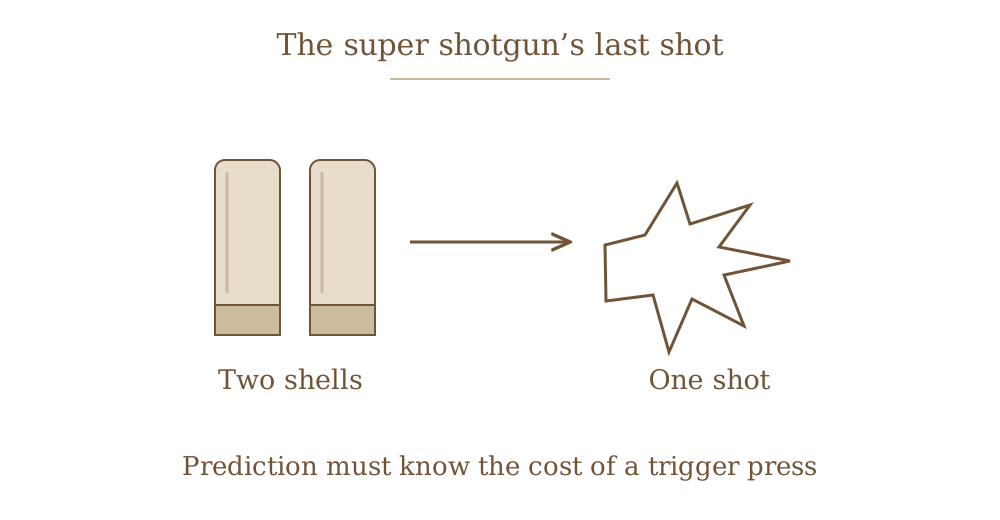
Work on Q2PRO-X 0.99 began on 13 April. One problem was a shot from an empty weapon: the ammunition was gone, but the client still managed to show a flash. Checking the HUD count was insufficient—the server had not yet reported ammunition spent on shots already predicted by the client. Unconfirmed shots began to be subtracted from the remaining count, and the cost of the next shot was checked. The super shotgun uses two shells; the chaingun's consumption changes as it spins up. The last round forced a careful recount of all the preceding ones.
Some bugs hid from the very logs intended to expose them. One diagnostic mode altered suppression of server effects: turn logging on and the fault disappeared. The logging had to be corrected before its evidence could be trusted. Even then, a match was needed. An automatic check could pass, only for a player to notice another missing or extra shot.